

What Is a Paper Cushioning Machine?
This packaging equipment is an "on-demand" paper-based packaging system installed at packing stations, allowing for the production of packaging materials exactly when and where they are needed. This approach eliminates the need for storage space for loose-fill materials (such as foam peanuts) and removes the requirement to stock pre-made packaging supplies like air-filled cushions.
Terminology for this equipment varies among suppliers. The same device might be referred to as a "paper void fill machine" (emphasizing its function of filling space within cartons), a "paper cushion making machine" (focusing on the form of the output), or a "kraft paper cushioning machine" (highlighting its protective capabilities). When comparing quotes, it is best to focus on technical specifications, such as paper width, basis weight range, cutting mechanism, and rated speed, rather than the product name.
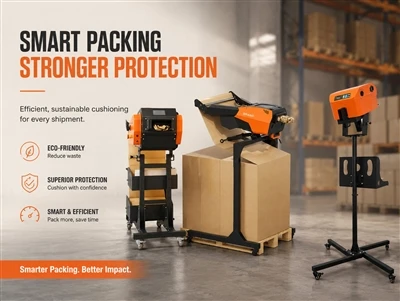
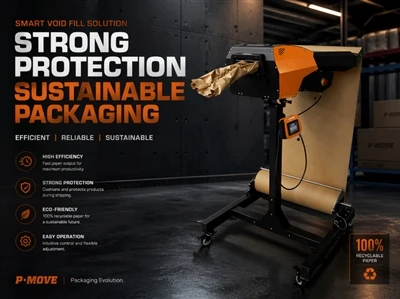
How does the paper cushioning machine work? Working principle
Every paper cushioning machine performs the same four functions. Models differ in how each is executed.
1. Paper feed
Fanfold paper withdraws flat from a zig-zag stack: no core waste, and several stacks can be staged so a run does not stop at a paper change.
There is little difference in the paper-feeding process between rolled paper and fanfold paper. The main distinctions are that purchasing options for fanfold paper may be more limited locally, and it tends to be slightly more expensive; however, in terms of the protective cushioning effect achieved, there is no significant difference.
Grammage follows the forming method: 50 to 80 gsm on single-layer concertina machines, up to 110 gsm single-layer on the NP-EC380, and 70 to 125 gsm on 760 mm industrial paper.
2. Tension control
Excess tension fractures the sheet along the crease and produces short scrap sections. Insufficient tension lets the forming elements slip, and the pad exits flat with no cushioning height. Tension is set mechanically and re-checked when grammage changes.
3. Forming
"Concertina folding" uses an internal gear mechanism to fold paper back and forth. The resulting cushioning pads are relatively thin, but the process offers high linear output speeds; this method is well-suited for lightweight packaging, primarily serving to keep products securely in place.
"Gear forming" utilizes two sets of meshing gears to compress and shape the paper. This produces a denser cushioning structure that retains its thickness even under pressure. While the linear operating speed is lower, it provides superior cushioning protection per unit of length.
According to measurements by NRTEC (under their specific test conditions), the gear-forming mechanism used in the NP-EC380 model offers approximately 38% better shock absorption than loose-fill foam packing peanuts.
4. Cutting
Automatic cutters on the NP-P30, NP-EC380 and P760 cut to a length entered on the control panel. The NP-P10 and NP-S1 have no blade; the operator separates each pad by hand. The cutter affects labour more than the speed rating does, because manual tear adds a handling step to every carton.
What is the speed range of the paper cushioning machine system?
| Model | Speed | Pads/min at 200 mm | Pads/min at 300 mm |
| NP-EC380,P760 | 30m/min | 150 | 100 |
| NP-P30 | 70m/min | 350 | 233 |
| NP-P10 | 105m/min | 525 | 350 |
These are continuous-output figures. A manual station never runs continuously because the operator paces the cycle. A station closing one carton every 20 seconds handles 180 cartons per hour. At three pads per carton, that is 540 pads per hour, or 9 per minute. Against a 70 m/min machine producing 350 pads per minute at 200 mm length, utilisation is roughly 2.6%.
Rated speed becomes binding only where one machine serves four or more benches, where pads feed an automated box-on-demand line, or during seasonal peaks. Linear speed and pad count are also different measures: the P760 is rated at 30 m/min but produces up to 200 pads per minute, because its 760 mm paper runs short and wide.
How to choose the right paper cushioning machine model for your needs?
| Model | Rated output | Paper specification | Cutting and control | Typical application |
| NP-P10 | 105m/min | 50 or 70 gsm fanfold | Manual tear; foot pedal | High-volume light parcels |
| NP-P30 | 70 m/min | 50 to 80 gsm single layer | Built-in cutter; 3 modes;LED touchscreen | Void filling and protection within the box |
| NP-EC380 | 30m/min | 38 cm wide; single layer 50 to 110 gsm, double layer 50 to 80 gsm; roll or fanfold | Automatic cutter; 4 modes; touchscreen | 200 to 1,500 cartons a day; general default |
| P350 | 30m/min |
Paper roll, 350mm wide, center-pull (50-90 gsm; 70-80 gsm recommended |
LED touchscreen,foot pedal | Fragile and high-value goods; 3D pads |
| P760 | 30 m/min; up to 200 pads/min | 760 mm wide; 70, 90, 125 gsm; pallet fanfold or roll | Automatic cutter; 4 modes; optional RS232 | Heavy industrial parts; wide cartons |
Selection Criteria
1. Local Paper Availability. The width and basis weight (grammage) of the paper must align with the stock specifications offered by the buyer's local paper suppliers. Relying on imported consumables implies a long-term dependency on external supply chains following the equipment purchase.
2. Compatibility Between Cushioning Pads and Carton Dimensions. The cushioning pads must be capable of spanning the voids within the cartons. A 38 cm-wide unit is suitable for most e-commerce cartons, while a 76 cm-wide unit is designed for larger cartons where narrower pads would be insufficient to fill the gaps.
3. Cutting Mechanism. An automatic cutting function is ideal for workstations with continuous, high-volume operations, whereas a manual tear-off mechanism is better suited for lower-volume stations where equipment speed is not the primary factor dictating the overall workflow pace.
4. Number of Workstations. A common configuration is one unit for every two workstations. The primary considerations here are the distance staff must travel and the logistics of paper distribution, rather than the raw output capacity of the equipment itself.
5. Maintainability. The specific type of cutting blade, the ease of accessing and servicing the forming mechanism, and the responsiveness of after-sales support are far more critical than the duration of the warranty period. For instance, if replacing a blade requires a six-week lead time, the production line could face downtime even while the equipment is still under warranty.
Before placing an order, always request a demonstration using the actual paper you intend to use; the recycled fiber content in the paper can significantly affect its stiffness and folding characteristics.
A paper cushioning machine is specified correctly when pad quality, cutter configuration, and station count drive the decision, with rated speed treated as secondary. The two figures that best predict the right model are cartons per day at peak and the internal gap the pad must bridge.
FAQ
Q: Is a paper cushioning machine the same as a paper void fill machine?
A: Yes. Both describe equipment that converts paper into padding at the packing bench. Compare specifications on paper width, grammage range, cutter type and rated speed, since names are not used consistently.
Q: How many cartons can one machine support?
A: On a manual bench, the operator limits output to roughly 150 to 200 cartons per hour regardless of machine rating. One machine serves up to about four benches before paper logistics reduce the benefit.
Q: Which grammage should be used?
A: 50 to 70 gsm for parcels under about 2 kg where the pad's function is positional. 70 to 90 gsm for fragile items and larger cartons. 110 to 125 gsm for industrial parts and sustained load.
Q: What is the minimum order and lead time?
A: One unit for standard configurations, 20 for customised units, and 15 to 20 days of production after deposit.