Views: 0 Author: Site Editor Publish Time: 2026-07-31 Origin: Site
Modern distribution centers face a severe operational constraint today. Industrial real estate costs continue rising at unprecedented rates. Warehouse managers experience intense pressure to increase storage density rapidly. Expanding the existing facility footprint often proves far too expensive. Consequently, facilities are transitioning away from traditional horizontal floor storage. We see a massive shift toward high-density vertical racking systems instead. This critical transition demands specialized material handling equipment. Upgrading your fleet to electric machinery is never just a simple equipment swap. It represents a highly strategic facility decision. This choice directly impacts your overall space utilization, financial returns, and ESG compliance. We will explore the harsh operational realities of deploying these advanced machines. You will understand their direct financial justification and strict implementation prerequisites. This guide maintains an evidence-based tone for procurement officers and warehouse operators. We aim to provide clear, actionable insights for your upcoming fleet upgrades.
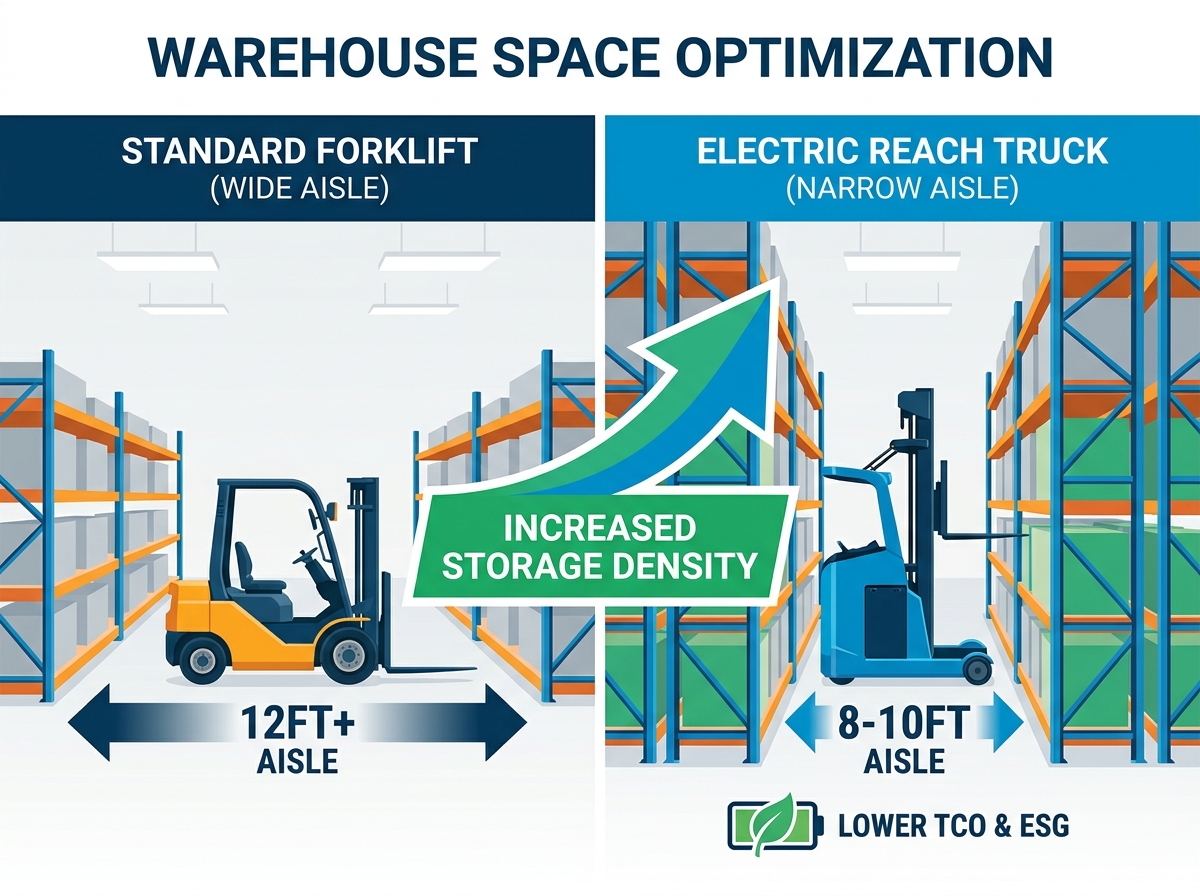
Space Optimization: Electric reach trucks enable aisle width reductions (often down to 8-10 feet) and safely navigate lift heights exceeding 10 meters, drastically increasing cubic storage volume.
TCO Reduction: Lower maintenance overhead, elimination of fuel costs, and reduced need for off-site warehouse expansion yield a measurable ROI.
Operational Shifts: Adoption requires specific facility prerequisites, including strict floor flatness tolerances and compatible racking base clearances.
ESG & Safety: Zero-emission electric powertrains support corporate sustainability mandates while improving indoor air quality and operator ergonomics.
Standard counterbalance forklifts create significant spatial challenges. They rely on heavy rear weights to balance frontal loads. This design necessitates a rather long equipment chassis. A longer chassis demands extremely wide warehouse aisles. Traditional forklifts typically require 12 feet or more just to turn and load pallets safely. This wastes premium warehouse floor space across your entire facility. When industrial real estate prices soar, wasting square footage limits your revenue potential.
The specialized reach mechanism solves this spatial problem elegantly. These machines utilize either a scissor-like pantograph or a moving mast system. The machine physically pulls the loaded pallet back within its own wheelbase before traveling. This unique action drastically shrinks the required turning radius. Operators can navigate safely in much tighter spaces. You immediately unlock valuable floor area for extra pallet positions. Reach Trucks fundamentally change how you plan your floor layout.
You must evaluate your daily operational bottlenecks carefully. Standard machines perform well in specific environments. However, narrow-aisle environments demand dedicated solutions. Below is a simple matrix comparing these two equipment types. Use it to guide your procurement strategy.
Equipment Selection Matrix
Operational Requirement | Counterbalance Forklifts | Electric Reach Machines |
|---|---|---|
Primary Application Environment | Indoor and outdoor use | Strictly indoor use on smooth floors |
Aisle Width Tolerance | 12 to 14 feet | 8.5 to 10 feet |
Loading Dock Tasks | Excellent for trailers and dock plates | Not recommended (low clearance) |
Vertical Storage Capacity | Limited high-level stability | Exceptional stability above 10 meters |
Maximizing your vertical real estate remains crucial. Traditional machines quickly lose load capacity at higher elevations. The physics of a counterbalance system pushes the load center outward. This creates instability during high-lift operations. Conversely, specialized reach machines retain excellent capacity at extreme heights. Their design places the heavy load directly over the stabilizing outrigger legs. You maintain superior stability even when lifting pallets 30 feet high. This design empowers you to utilize your facility's full clear height.
Precision and maneuverability separate these machines from older technology. They feature articulating load wheels for smoother travel. Advanced mast staging ensures zero jerking motions during lifts. Programmable lift speeds help reduce cycle times significantly. Operators can work faster within Very Narrow Aisles (VNA) safely. These tight aisles demand absolute precision to avoid racking impacts.
Operator ergonomics play a major role in facility productivity. Poor visibility causes fatigue and increases product damage rates. Modern equipment introduces several distinct ergonomic improvements:
Side-stance seating: Operators stand at an angle. They can easily look forward or backward. They avoid straining their necks continuously.
Open overhead guards: Angled roof bars provide a clear upward line of sight. Operators can spot top-tier rack beams easily.
Mast camera systems: High-definition cameras beam video to a dashboard monitor. This minimizes blind rack damage during high-level pallet placements.
Intuitive joystick controls: Operators manage travel, lift, and reach functions using one hand. This reduces physical motion and operator fatigue.
You must look beyond the initial purchase price. Direct operating costs matter significantly over a five-year lifecycle. Modern electric drivetrains offer exceptional energy efficiency. Lithium-ion batteries specifically outperform traditional Lead-Acid options dramatically. Lead-acid units require daily watering. They also emit harmful gases during their charging cycle. You must build expensive, dedicated ventilation rooms for them. Lithium-ion systems eliminate these costly facility requirements entirely. They charge faster and endure more shift cycles.
Maintenance and downtime drag down your operational profitability. Internal combustion engines require frequent preventative maintenance. You constantly pay for oil changes, filters, and spark plugs. Electric systems require far less intervention. They simply have fewer moving mechanical parts. Furthermore, regenerative braking systems actively reduce physical wear on brake components. The truck slows down automatically when operators release the throttle. Diagnostic telemetry software alerts your mechanics before catastrophic failures occur. This proactive approach improves overall fleet uptime considerably.
We must also evaluate direct facility ROI. You should frame your financial expectations around the entire warehouse footprint. Investing in high-density Reach Trucks unlocks 20-30% more storage capacity instantly. You achieve this merely by shrinking your aisle widths. This massive capacity boost can defer expensive real estate decisions. You might completely eliminate the massive capital expenditure of acquiring a new warehouse. Maximizing your existing footprint always yields the highest financial return.
Corporate sustainability goals shape modern logistics decisions today. Zero-emission operations are no longer optional for large enterprises. Electric material handling equipment connects directly to your emission reduction targets. Transitioning your fleet helps achieve Tier 1 and Tier 2 corporate mandates. Internal combustion engines pump exhaust fumes into enclosed spaces. Electric powertrains eliminate this hazard completely. You easily maintain compliance with increasingly strict indoor air quality regulations. Your warehouse environment remains cleaner and healthier for everyone.
Noise reduction provides a fantastic secondary benefit. Propane and diesel engines generate severe acoustic pollution. High decibel levels cause chronic fatigue on the warehouse floor. Excessive noise also masks important warning alarms. Electric motors operate quietly by comparison. A quieter facility improves verbal communication among your team members. It boosts overall safety awareness significantly.
Advanced safety features reassure highly risk-averse stakeholders. These specialized machines include both standard and optional safety technology. These systems protect the operator, the load, and the racking infrastructure.
Automatic speed reduction: The machine senses sharp curves. It slows down automatically to prevent tipping accidents.
Lift height limiters: Sensors detect overhead obstacles like sprinklers. They prevent the mast from rising past safe thresholds.
Anti-slip traction control: Intelligent drive wheels maintain secure grip. They prevent dangerous sliding on slick or dusty concrete surfaces.
Operator presence pedals: The machine halts instantly if the operator removes their foot. This prevents runaway accidents if someone faints or falls.
You must address specific facility prerequisites before deployment. Floor Flatness (FF) requirements are absolutely critical. High-mast equipment requires highly level concrete floors. A minor bump on the floor translates to severe mast sway 30 feet above. This sway endangers operators and damages rack structures. Industry experts measure this using F-min standards. You must never deploy these machines on degraded concrete. You must schedule professional floor remediation first.
Racking compatibility presents another common adoption hurdle. You must meticulously evaluate your base leg clearance. The bottom rack beam level must accommodate the equipment's protruding outriggers. If the outriggers hit the racking, the truck cannot deposit the pallet. You might need to raise your first rack level. Always ensure your existing rack designs match the specific equipment dimensions.
Training and change management require dedicated time. Operating a side-stance, joystick-steered machine differs greatly from driving a standard forklift. The learning curve is steep but manageable. Operators must learn to drive sideways comfortably. They must master complex multi-function joysticks. You must factor in proper certification hours. Do not expect maximum throughput on day one. Patience during training ensures long-term safety and efficiency.
Electric reach machines serve as highly specialized warehouse tools. Manufacturers design them specifically for high-density, high-throughput modern logistics environments. They solve severe spatial constraints better than any traditional alternative. By adopting them, you maximize your vertical space efficiently. You also reduce harmful emissions and lower daily operating costs.
Decision-makers should thoroughly audit their current operations first. Measure your exact aisle widths today. Verify your maximum required lift heights accurately. Review your daily shift cycles and battery demands before requesting vendor quotes.
Your next step requires careful spatial planning. We strongly encourage consulting with a professional material handling systems integrator. Ask them to conduct a comprehensive spatial audit. Project your exact financial returns before finalizing your fleet procurement.
A: They typically require between 8.5 to 9.5 feet of aisle space. This exact measurement depends on the specific chassis size and your pallet load length. Standard counterbalance forklifts usually demand 12 feet or more. Upgrading allows you to reclaim significant floor space for extra racking.
A: Most commercial models handle heights between 300 to 450 inches. This translates to approximately 25 to 37 feet vertically. Specialized high-level models can exceed these limits. Maximum height always depends on the specific mast configuration and the payload weight.
A: Generally, no. Their exceptionally low ground clearance restricts them. The protruding outrigger base legs and specialized hard wheels make them unsuitable for dock plates. They struggle on uneven surfaces or standard trailer floors. They are strictly designed for indoor, smooth-surface racking operations.
A: Battery life depends highly on the battery chemistry and application intensity. Traditional lead-acid batteries last one standard shift. Modern Lithium-ion setups allow for rapid opportunity charging during breaks. This modern capability easily enables multi-shift operations using a single battery asset.