Views: 0 Author: Site Editor Publish Time: 2026-07-23 Origin: Site
Scaling warehouse capacity often forces a tough operational choice. You must either expand your physical footprint or aggressively increase storage density. Standard counterbalance forklifts offer versatile, general-purpose solutions for most traditional facilities. Conversely, specialized narrow-aisle machines provide high-density vertical storage capabilities. Selecting the wrong equipment easily leads to damaged racking and serious workflow bottlenecks. It also dramatically increases operator fatigue during long demanding shifts. This guide breaks down exact technical capabilities and specific operator requirements. You will learn how to compare these machines accurately based on their mechanical designs and performance limits. We provide clear frameworks to support your next confident procurement decision. By understanding structural differences and visibility challenges, you can optimize your fleet safely. Let us examine the defining characteristics and operational boundaries of each vehicle type.
Core Function: Standard forklifts use a rear counterweight to lift heavy loads in wider spaces; reach trucks use stabilizing outer legs and an extending carriage to operate in narrow aisles.
Space Requirements: Forklifts typically require 11 to 13-foot aisles, while reach trucks can operate in aisles as narrow as 8 to 9 feet.
Lift Height: Reach trucks drastically outperform standard forklifts in vertical reach, comfortably servicing racking over 30 feet high.
Environment Constraints: Reach trucks are strictly for indoor, smooth-surface warehouse use; counterbalance forklifts can handle loading docks, trailers, and outdoor environments.
Operator Posture: Forklift operators sit facing forward; reach truck operators typically stand and work sideways, affecting training and ergonomic comfort.
Every piece of material handling equipment relies on fundamental physics to lift heavy pallets safely. We must examine the structural engineering behind these machines to understand their specific applications.
Traditional forklifts operate using a basic fulcrum principle. They rely heavily on a massive cast-iron weight integrated into the rear chassis. This dense counterweight offsets the heavy loads placed on the front forks. The front wheels act as the primary pivot point during lifting operations.
This design utilizes a fixed mast assembly. The mast tilts forward and backward to secure or release palletized loads. However, the forks themselves cannot extend outward away from the vehicle body. Operators must drive the entire machine close to the racking to deposit a pallet.
Because of this rear-heavy design, standard forklifts require a broader wheelbase. They inherently possess a longer turning radius. This larger footprint guarantees optimal stability during transit. It prevents the machine from tipping forward when carrying maximum capacity loads across long distances.
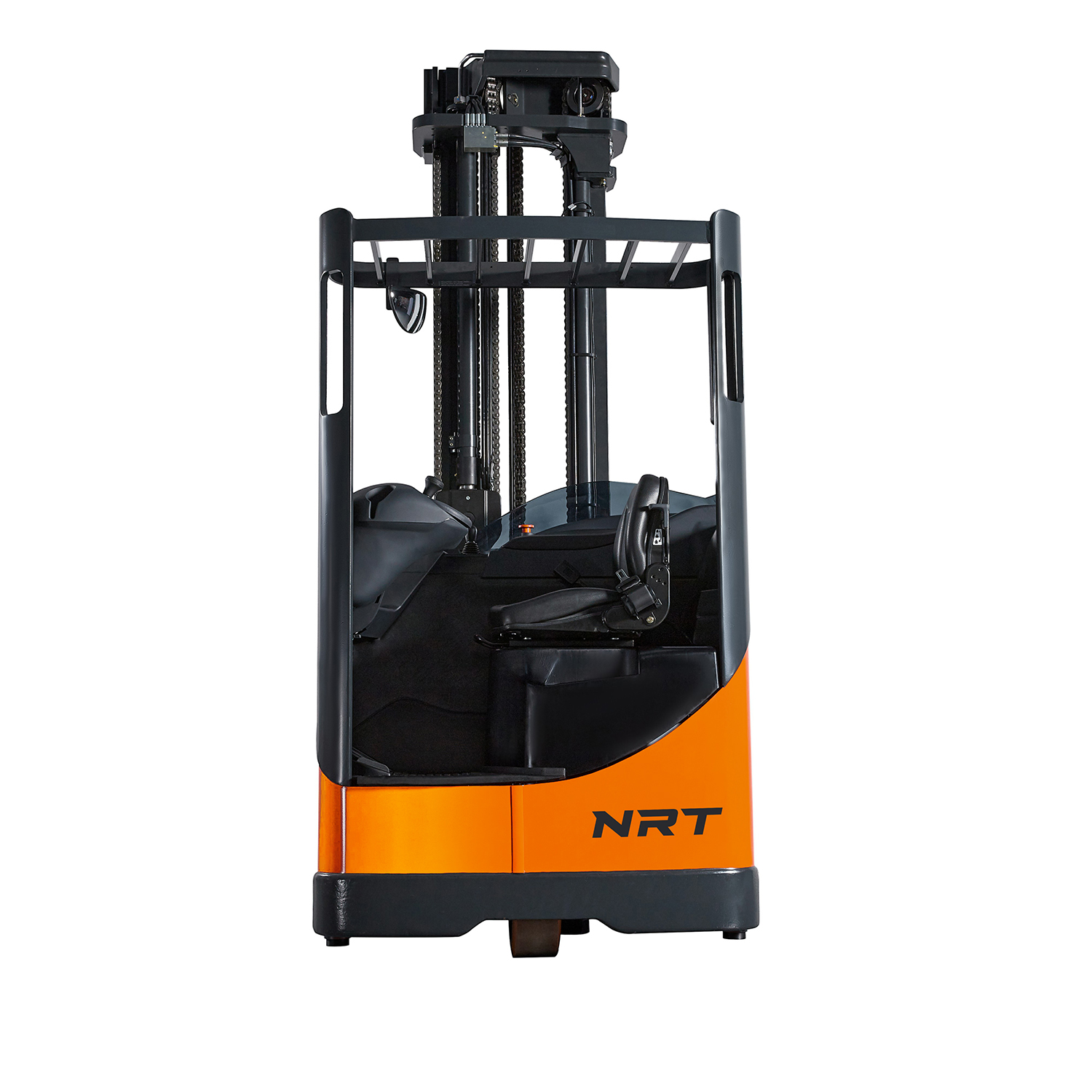
Specialized high-density equipment utilizes an entirely different stabilization method. These machines feature two outer stabilizing legs extending forward from the base. These base legs distribute the load weight efficiently across the floor. This clever engineering completely eliminates the need for a bulky rear counterweight.
The primary advantage lies in the dynamic reach mechanism. Reach Trucks utilize either a pantograph scissor mechanism or a moving mast assembly. The operator keeps the main chassis completely stationary in the aisle. They then extend the forks forward directly into the racking system to retrieve pallets.
This forward-reaching capability allows for a highly compact chassis. Engineers designed these machines specifically for extremely tight turning radii. The compact body allows the vehicle to navigate spaces where standard counterbalance equipment simply cannot physically fit.
Comparing these machines requires a close look at their operational limits. Facilities must balance space utilization against overall load capacity and environmental flexibility.
Facility layout dictates equipment selection heavily. Standard forklifts demand surprisingly wide aisles. They typically require 11 to 13 feet of clearance to achieve a full 90-degree turn. This wide turning arc is mandatory for safe pallet extraction.
In contrast, specialized narrow-aisle machines change the warehouse layout entirely. They are explicitly designed for narrow aisle racking configurations. These aisles typically measure just 8 to 9 feet across. Implementing these narrower aisles enables up to a 30 percent increase in total warehouse storage density.
Below is a mechanical comparison chart outlining the fundamental differences in operational parameters.
Operational Parameter | Standard Counterbalance Forklift | Reach Truck |
|---|---|---|
Minimum Aisle Width | 11 to 13 feet | 8 to 9 feet |
Primary Application | Dock-to-stock, heavy lifting, versatile terrain | High-density vertical storage, narrow aisles |
Base Stabilization | Rear cast-iron counterweight | Forward extending base legs |
Tire Composition | Pneumatic, solid rubber, or cushion | Smooth polyurethane |
Standard forklifts excel at handling exceptionally heavy loads at lower elevations. Their capacities routinely range from 3,000 to over 10,000 pounds. However, they face strict limitations regarding safe maximum lift heights. Pushing heavy loads too high compromises the rear counterbalance effect.
High-density machines are optimized specifically for vertical height rather than brute weight. They easily service racking reaching up to 400 inches or more. You must carefully monitor load capacity derating at these extreme elevations. A machine rated for 4,000 pounds at floor level cannot safely lift that same weight to 30 feet. Despite this derating, they safely retrieve lighter loads from double-deep racking systems.
Standard forklifts handle highly varied work environments effortlessly. They routinely unload semi-trailers directly. They navigate steep dock levelers without issue. Models equipped with pneumatic tires easily traverse uneven outdoor yard terrain and gravel.
Conversely, narrow-aisle machines possess zero outdoor capabilities. They feature a very low undercarriage clearance. They utilize small, solid polyurethane wheels. These wheels provide minimal shock absorption. Therefore, you must strictly limit their use to flat, high-quality indoor concrete floors.
Operating industrial machinery requires intense focus. The physical layout of the operator cabin drastically affects daily comfort, spatial awareness, and overall safety.
Standard equipment provides a highly traditional automotive experience. Operators sit comfortably in a suspended seat. They steer using a standard wheel and manipulate loads using straightforward hydraulic levers. This seated posture reduces lower body strain significantly.
High-density warehouse machines demand a completely different physical stance. Operators must stand inside a specialized compartment. They utilize complex joystick or tiller-style controls to maneuver. Standing for an entire shift causes notable foot and lower back fatigue. You must implement anti-fatigue floor mats and mandatory rest breaks to protect operator health.
Seated operators face forward directly toward their intended travel path. However, they struggle heavily with forward visibility once they load the mast. A large pallet severely obstructs their line of sight. They frequently must drive backward to see their surroundings safely.
Standing operators work in a sideways orientation. This unique stance allows them to travel in either direction smoothly. They simply turn their head left or right without straining their necks constantly. However, visibility challenges shift upward. The heavy overhead guard cage and complex mast mechanics can easily obstruct upward views during extreme high-level lifts.
You cannot simply move an experienced forklift driver to a narrow-aisle machine immediately. Transitioning involves a surprisingly steep learning curve. The hyper-sensitive steering mechanisms react differently. The sideways orientation constantly confuses spatial awareness initially.
To mitigate these serious operational risks, you must enforce dedicated training protocols. Facilities must adhere to distinct OSHA safety standards for stand-up riders. Operators must deeply understand the multi-axis control joystick before retrieving live loads.
Selecting the ideal machinery requires analyzing your daily workflow patterns. You must match equipment capabilities to your specific facility constraints.
You manage dock-to-stock workflows. Standard units quickly drive inside semi-trailers, grab pallets, and transport them directly to staging areas.
Your operations extend outdoors. Standard models easily navigate uneven asphalt, transition between separate buildings, and withstand variable weather conditions.
Your facility features standard-width aisles. If you already have wide aisles and prioritize heavy load capacity over extreme vertical storage, traditional models serve you best.
You encounter steep gradients. Standard units possess the necessary ground clearance to cross dock plates safely without getting stuck.
You are transitioning to high-density layouts. Moving to Narrow Aisle (NA) or Very Narrow Aisle (VNA) racking maximizes expensive warehouse real estate effectively.
Your workflow isolates unloading from put-away. The most efficient warehouses use traditional machines to drop pallets at end-of-aisle staging areas. Reach Trucks then handle the dedicated vertical put-away process.
You utilize specialized storage systems. Double-deep racking requires deep-reach variants equipped with extended pantograph mechanisms to access rear pallets safely.
Your facility maintains pristine floors. You have perfectly level, smooth concrete free from large expansion joints or debris.
Choosing between standard counterbalance machines and specialized narrow-aisle equipment directly dictates your warehouse layout capabilities. Standard forklifts remain the highly versatile workhorses of bustling loading docks and outdoor yards. They effortlessly handle heavy loads across uneven surfaces. Conversely, high-density machines serve as precision tools. They allow you to maximize expensive vertical warehouse real estate by operating safely in extremely tight aisles.
High-throughput warehouses rarely rely entirely on just one equipment category. The most resilient and efficient fleets blend both effectively. They deploy robust counterbalance models for rigorous dock operations. They simultaneously utilize narrow-aisle machines exclusively for high-density storage retrieval. This hybrid approach prevents bottlenecks and optimizes cycle times.
Before finalizing any procurement decision, you should consult an equipment specialist. Conduct a comprehensive site survey together. Accurately measure your existing aisle widths, assess current floor conditions, and verify maximum racking heights to ensure safe, productive operations.
A: No. Their notably low ground clearance makes navigating angled dock plates highly dangerous. They are not engineered for the varying gradients and uneven transitions found on standard loading docks. Attempting this frequently causes the machine to get stuck or damaged.
A: Yes. The standing sideways posture completely alters spatial awareness. This posture, combined with highly sensitive steering and a complex multi-axis control joystick, requires specialized training. Operators generally need a much longer adaptation period to feel confident and safe.
A: No. Their solid polyurethane tires provide zero shock absorption. Their extremely low undercarriage is strictly designed for perfectly flat, smooth indoor concrete floors. Using them outdoors risks severe equipment damage, wheel destruction, and potential tipping hazards on uneven terrain.